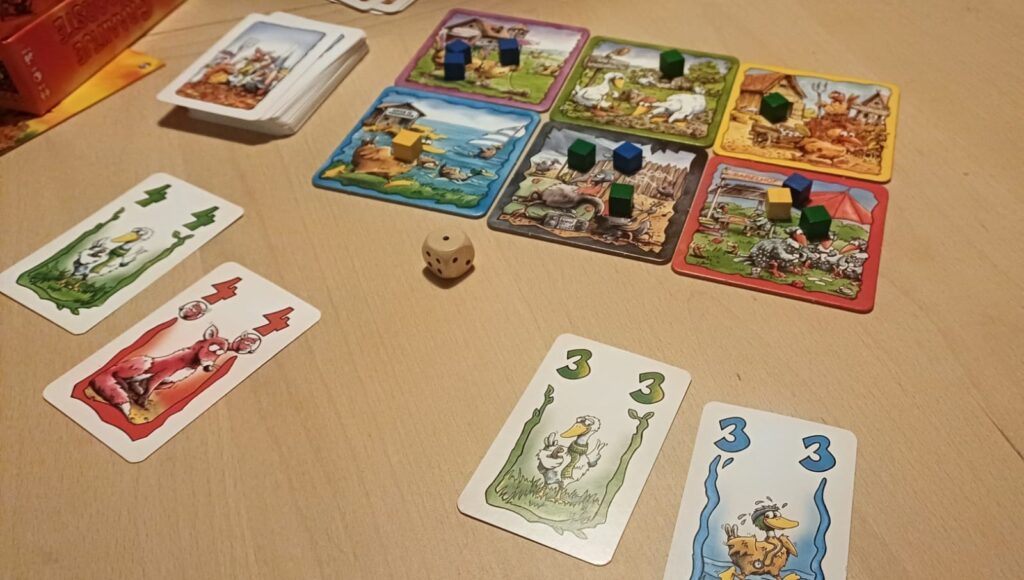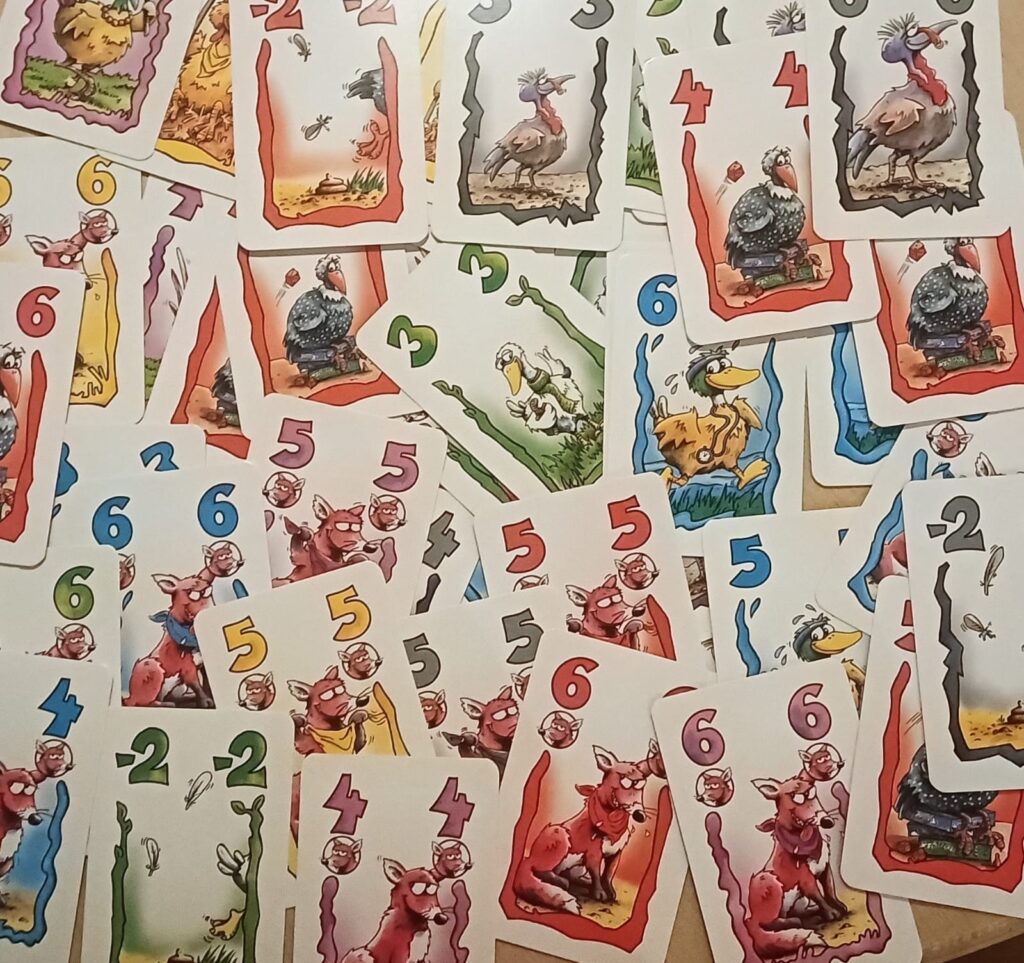
Graantje de Voorste is a new edition of Stefan Dorra’s game from the early 2000s, illustrated by Doris Matthäus, and takes place on a farm. All the chickens, guinea fowl, pheasants, ducks, geese and turkeys in the neighbourhood are feasting on freshly scattered grain, while the local foxes look on with a very different menu in mind: duck breast, stuffed turkey or roast pheasant. The box contains 6 henhouses, 42 poultry cards and 18 fox cards in 6 colours, 78 grains in 3 colours (39 green, 26 blue and 13 yellow), and a die. The henhouses are placed next to one another on the table, with the animal cards in a face-down deck beside them. I played a two-player game, in which each player is dealt 6 cards; with 4 to 6 players, everyone gets 5. The grains stay in the box.
The game lasts 13 rounds, each consisting of 4 phases. During the scattering phase, one player places a single grain in each henhouse without looking. The grain’s colour determines its value: green is worth 1 point, blue 2 and yellow 3. Everyone then secretly chooses a card from their hand and reveals it simultaneously. The colour determines which henhouse your animal visits to look for food. If there is only one bird in a henhouse, that player takes all the grain. If there are several birds, the players can agree on how to divide it, but if they cannot reach an agreement, a dice battle decides who walks away with the grain. The die roll is added to the value on the card played.
Foxes do not eat grain; instead, they go after poultry of the same colour. If there are several foxes of the same colour, another dice battle is needed. Each bird species also includes one timid specimen with a value of -2, affectionately known as the “schijtlijster” (in Dutch). When alone in a henhouse, it is brave enough to gobble up all the grain, but as soon as another animal of the same colour turns up, it flees immediately, snatching a single green grain on its way out if one is available. Also, when there is a fox in the henhouse, although in that case it also ends up on the fox’s menu.
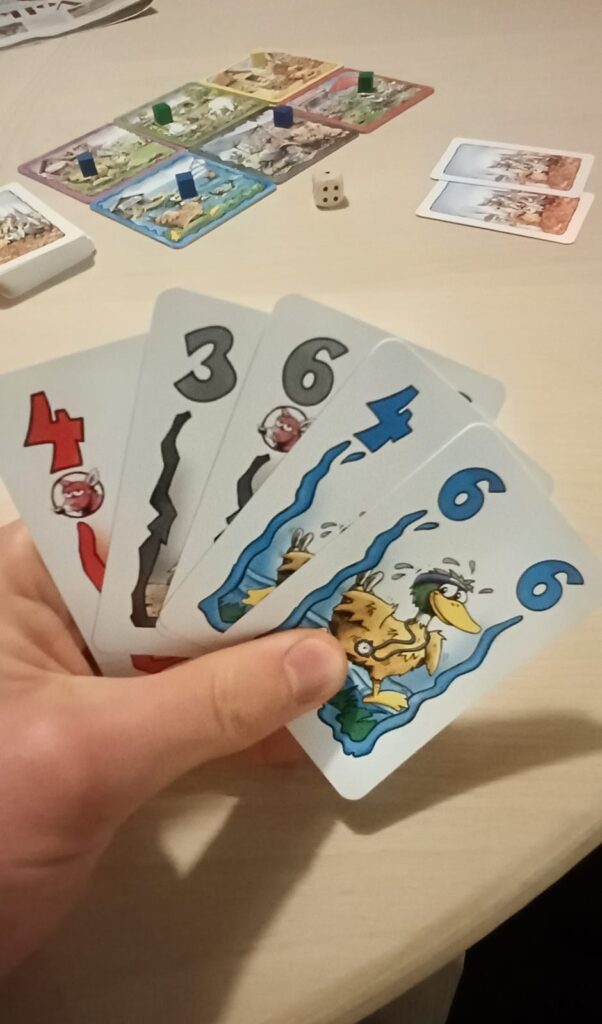
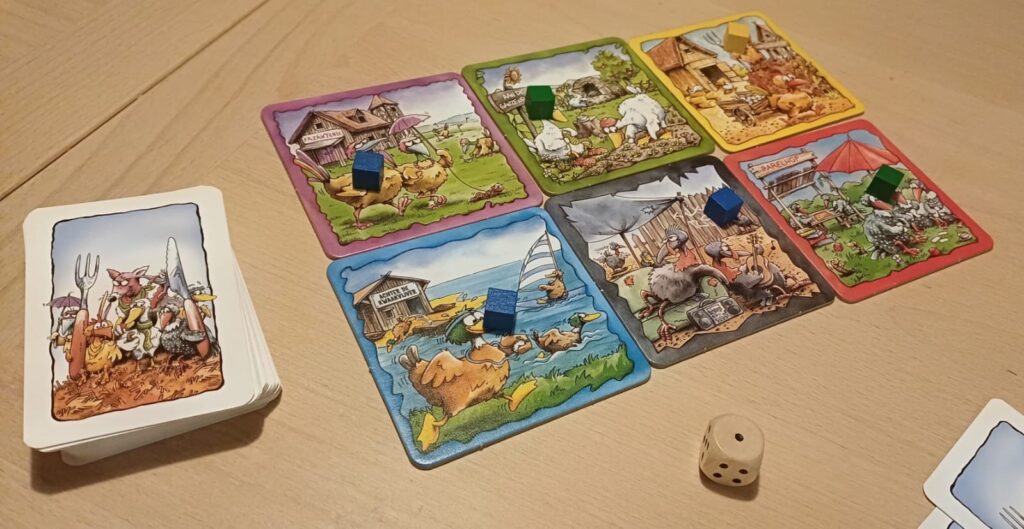
Once the spoils have been divided, everyone draws a new card from the deck and the next round begins. Any grain left over from previous rounds stays in the henhouses. After the thirteenth round, which begins when the final six grains have been scattered, everyone adds up the points from their grain and birds, and the player with the most points wins. In the event of a tie, the player with the higher total value in grain or poultry cards wins.
That is Graantje de Voorste in a nutshell, and its simplicity is precisely what makes it so appealing. The rules are easy to grasp, and a game generally takes no more than 20 minutes. It works well with 2 players, but I think it becomes a lot more entertaining with a larger group, as several players may end up searching for food in the same henhouse at the same time. The publisher has come up with a solution for 2 or 3 players by allowing you to play two animals at once, but it still does not feel quite the same.
A great “snack” for a games night with friends!