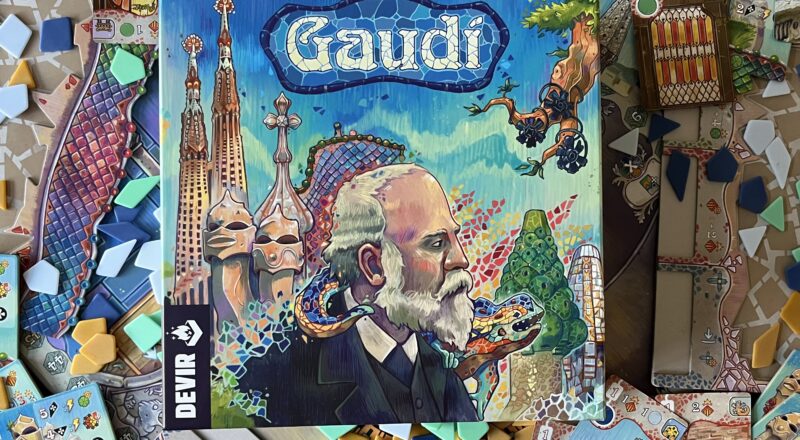
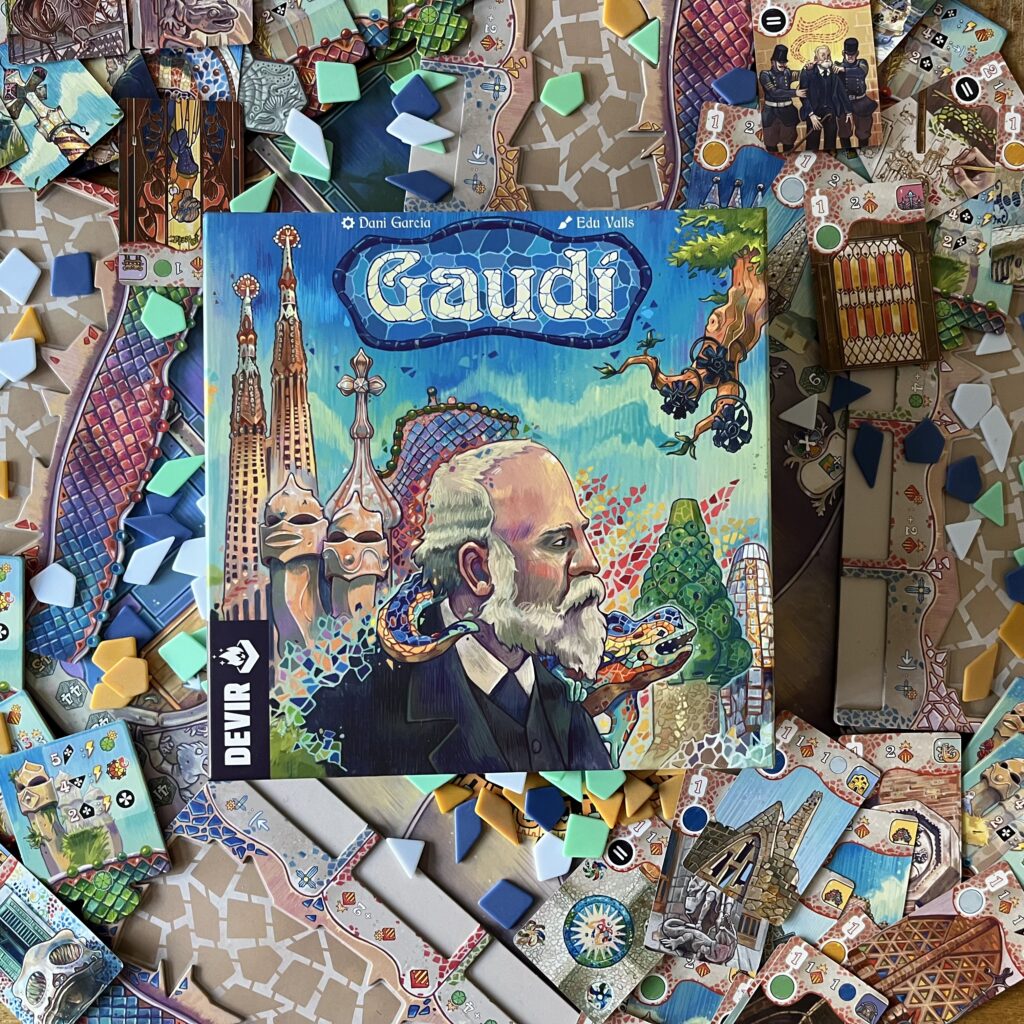
What comes to mind when you think of Gaudí? Lots of color, plenty of beautiful, artistic buildings, a church that never seems to be finished, but above all, remarkable mosaics. Gaudi brings many aspects of Gaudí together in a distinctive Eurogame that feels like a respectful tribute to him.
Theme and objective
The board game Gaudi is, of course, about none other than Gaudí himself: architect, designer, artist, visionary, and perhaps even something of a revolutionary. One detail I enjoy in many of Devir’s historical board games is the way their rulebooks approach the theme. They explain the history behind it and how that history informed certain design choices. The rulebook for Gaudi is likewise full of historical and cultural flavor.
Antoni Gaudí was hardly the kind of architect to say, “A plain, straight wall will do.” The Catalan designer gave Barcelona buildings full of flowing shapes, color, and surprising details. His work sometimes looks more like something out of a fairy tale than something drawn on a drafting table. Building a house? Sure, but make it one that makes you stop and stare.
Nature was his greatest source of inspiration. You can see it in the organic shapes of his architecture and the colorful mosaics of Park Güell. With its flowing lines and dragon-like roof, Casa Batlló is anything but ordinary, too. With Gaudí, even a façade seems to be thinking: a little extra imagination can’t hurt.
And then, of course, there is the Sagrada Família, which he worked on for much of his life. He certainly did not hold back when bringing his ideas to life in that building. That is what makes Gaudí so enjoyable: his architecture is not just something to look at, but something to marvel at. Your neck might get a workout, but your eyes will never be bored.
Several things were central to his life: nature, Catalonia, and religion. For Gaudí, this may have been a constant internal struggle. Which subject and which passion should I devote the most attention to, and what really defines me? All three, of course, but this struggle also appears in the board game. The game has three victory tracks tied to these themes from Gaudí’s life. You do not win by having the highest combined score across the tracks: it is the lowest scores that determine the winner. If you focus on one subject and neglect the others, those two neglected subjects will, unfortunately, be what you are remembered for.
Over three rounds, players therefore try to score evenly across the three tracks. They also try to place colorful tiles on their personal boards, in true Gaudí style. In real life, Gaudí frequently used trencadís tiles to create colorful mosaics. These mosaics are typically Catalan. The mosaics on your player board also earn you points at the end of the game. Gaudi is steeped in all things Gaudí, then, but does it really make you feel like him?
Gameplay
Gaudi is a true Eurogame. Actions, combos, little luck, plenty of strategy, and a defined set of actions that players turn into their own little engine to earn as many points as possible. An action never does just one thing. At least, not if you play it right.
Over three rounds, players move around a rondel on the main board. You move your pawn forward and carry out the action or actions at the space where you land. If you take the risk of moving ahead on the board, you get to perform both the pencil and hammer actions. At the end of the rondel is a tile with extra actions. The first player to reach it may perform both actions shown and triggers the end of the round. Players who have already reached the dark section of the rondel effectively have just one turn left that round.
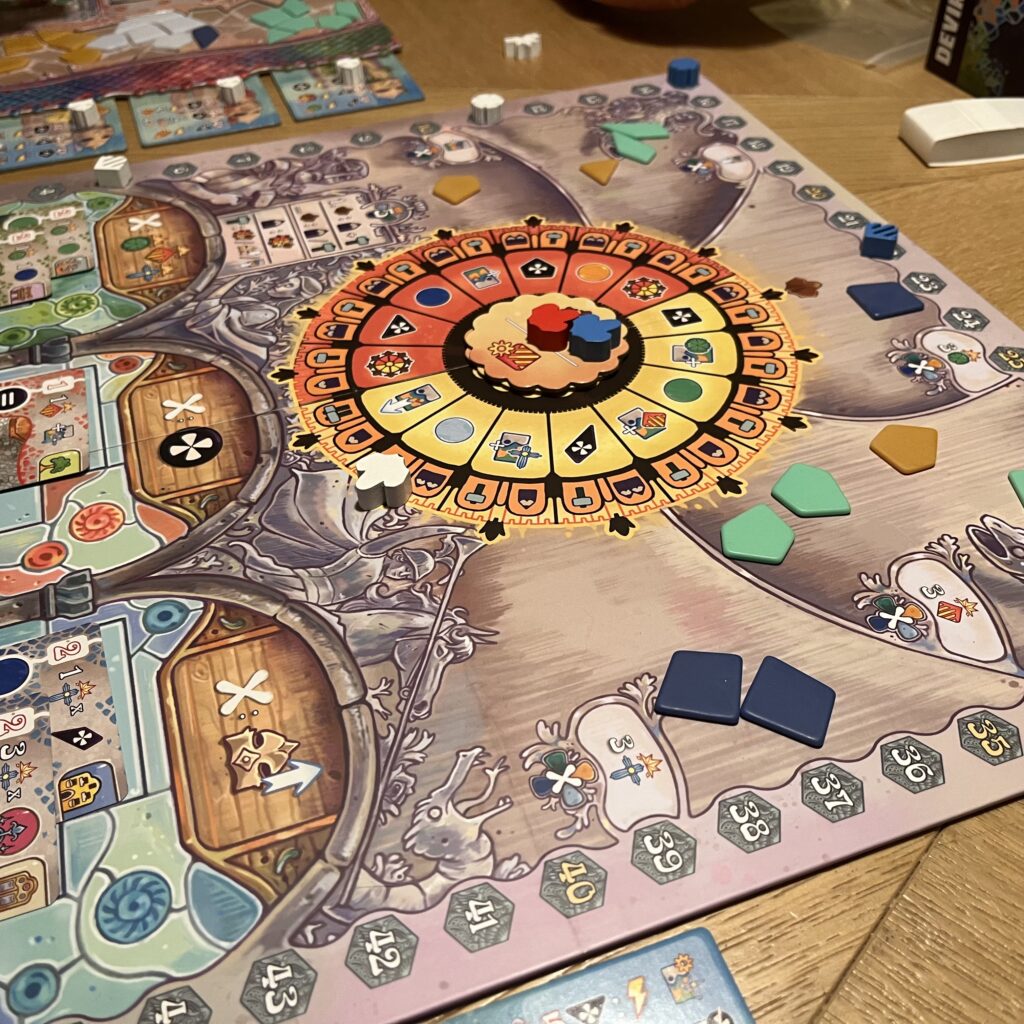
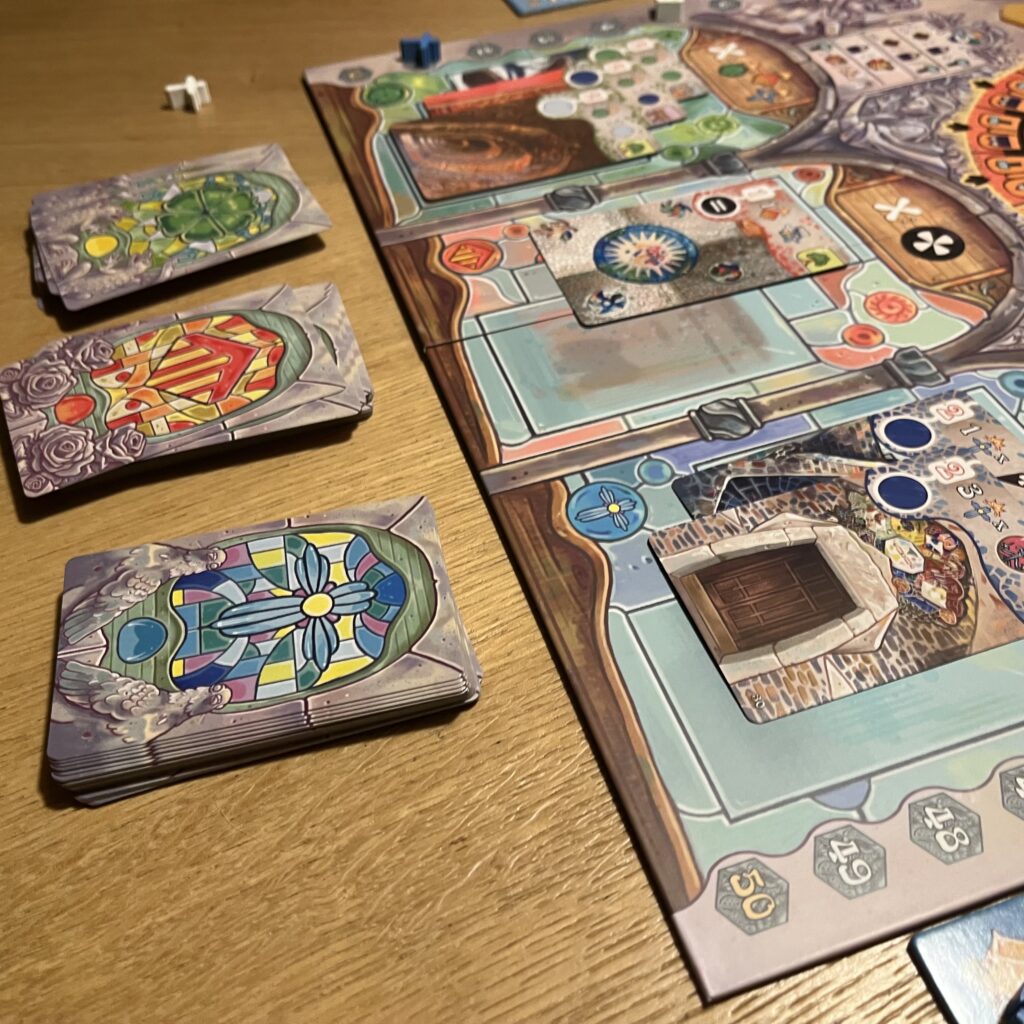
Pencils only let you perform the action shown. This often means taking a trencadís tile of a particular color or shape, or a card linked to one of the three themes from Gaudí’s life. Hammers also let you play cards or advance along one of the chimneys above your player board, allowing you to trigger bonus actions.
You use tiles to create groups of particular colors to score points at the end of the game. Cards let you build an engine. Before you can play a card, you must meet its requirements. You need a certain number of tiles of a particular color on your board to play it. Each card you play in one of the three categories makes the next card in that category more expensive. These categories correspond to the scoring tracks and the three themes from Gaudí’s life. During the game, you will activate the cards you stack beneath your player board. Cards in the nature category activate whenever you play a nature card. The Catalonia cards generally activate at the end of a round. The religion cards score at the end of the game. Each stack of cards generally earns points in its corresponding category, or provides other bonuses, such as extra tiles.
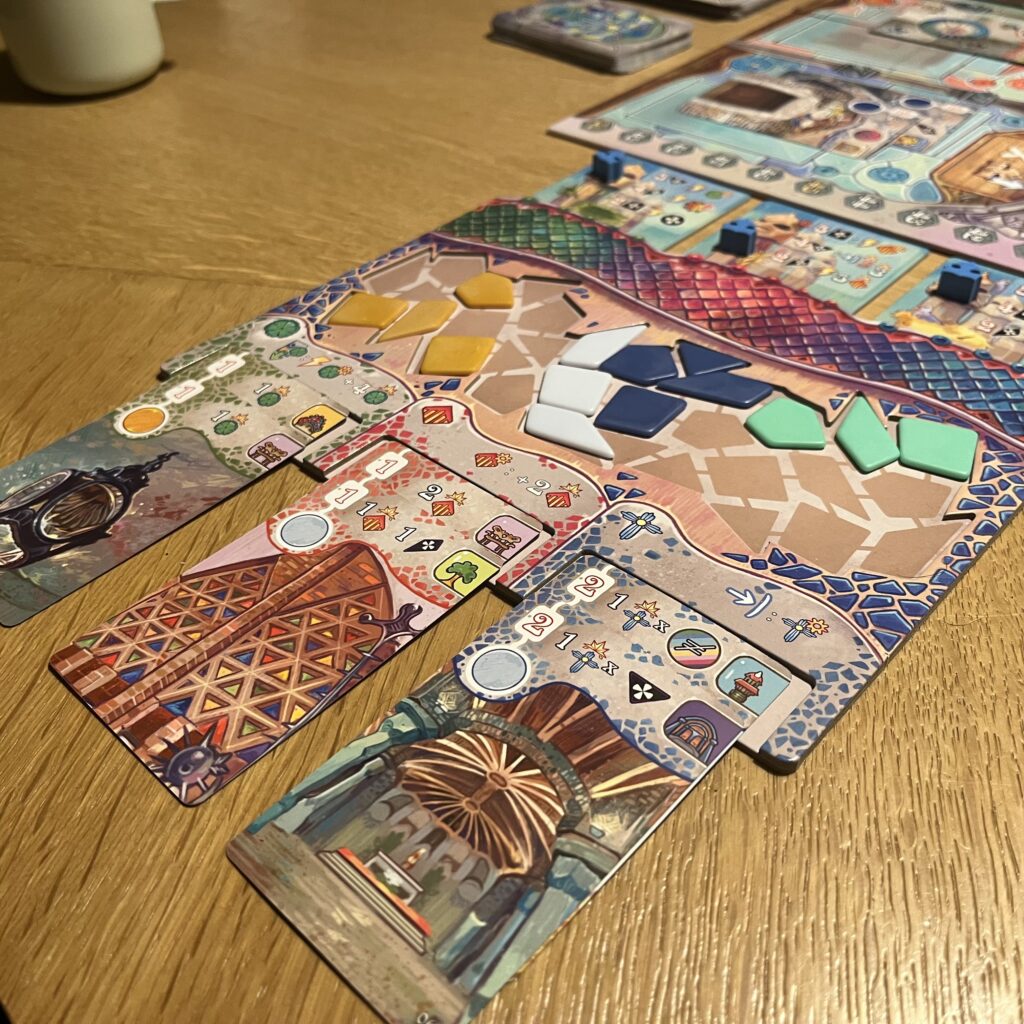
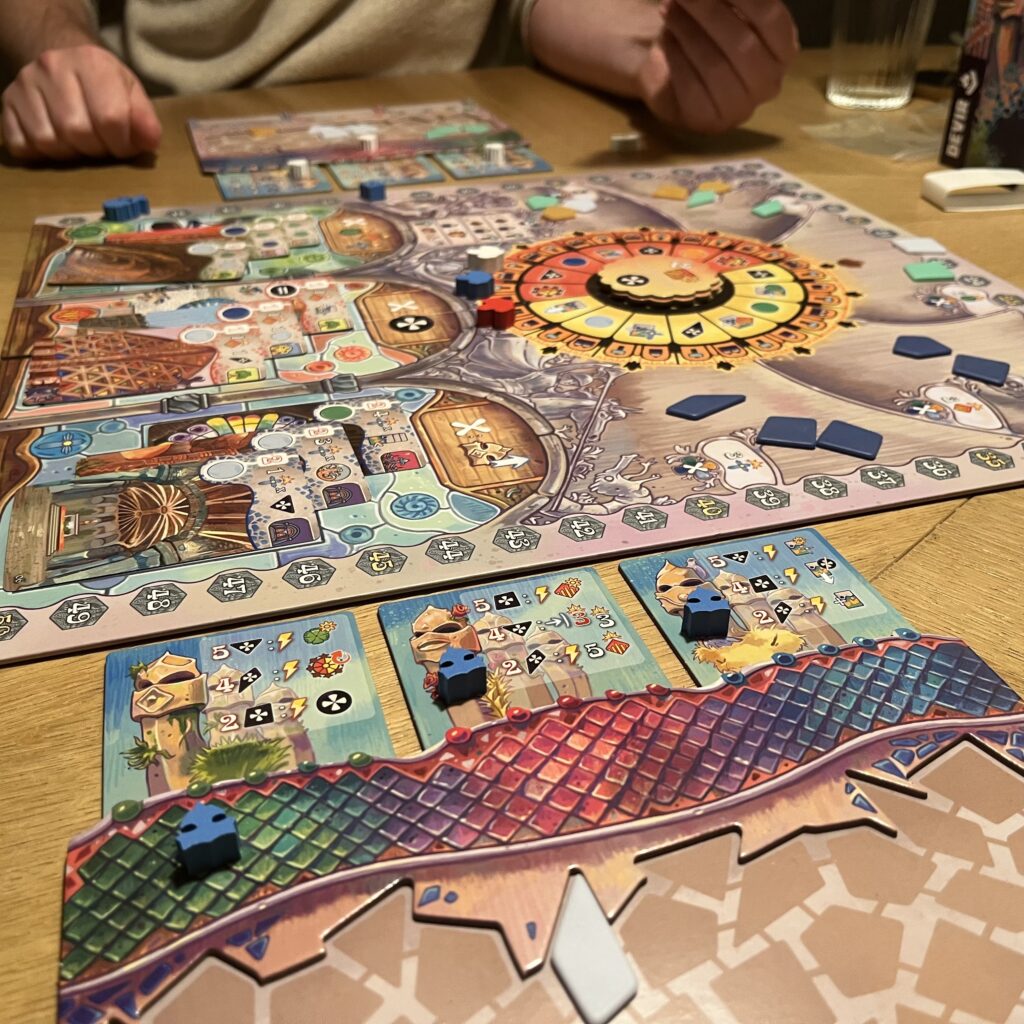
When you take cards and tiles from the board, they are not replaced immediately. They are only replenished once a space is empty, and the player who takes the last card or tile from a space receives a bonus action. You can always see which tiles and cards are available, which creates plenty of tactical decisions and a degree of player interaction.
Verdict
Gaudi is steeped in its theme and shows great respect for Gaudí’s work. It really does feel like a tribute to him, yet apart from placing tiles, it does not quite feel as though you are following in his footsteps. Instead, it feels more like a journey through his life and work. That does not change the fact that the game is beautifully presented and highly thematic. The designers have also deliberately made gameplay choices that reflect Gaudí, such as the three victory tracks and card categories.
Gaudi features plenty of interesting and unique gameplay elements. The way the three victory tracks connect to the three card categories, together with the way card order determines which tiles you need in order to play cards, feels refreshing. I have yet to discover the best strategy for the rondel, though. Sometimes it feels as if the starting player may have an advantage, although that might just be an impression. I also wonder whether it might always pay to stay at the front of the rondel so you can activate both the pencil and the hammer. Overall, Gaudi is a beautifully presented, colorful, and interesting game.